

Late winter is a deceptive time for a mixer. The machine has been sitting, or running lighter rations, and everything looks fine until the first heavy spring batch reveals a problem that has been building since August. Dust gets into things. Oil circuits that were marginal in July become failures in September. And when feeding demand climbs back up, the last thing you want is a gearbox starved of oil in the middle of a morning mix.
This is specifically about one failure mode that does not announce itself loudly until it already has you stopped: fine forage dust entering the lubrication circuit through an open breather, slowly building an airlock, and eventually starving oil flow to the auger gearbox. It is common enough that anyone running a trailed vertical mixer should be checking for it before the spring schedule resumes.
How Dust Gets Into the Oil Circuit
The physics of it are straightforward. Every time an auger gearbox heats up during a mix cycle and then cools down, the air inside the gearbox contracts. On a conventional open breather design, that contraction draws ambient air back in through the breather port. If the breather is mounted underneath or beside the auger, it sits in exactly the worst place: directly in the path of the fine dust cloud that rises off dry hay, straw, and processed silage during mixing.
Dust particle by particle, that material works into the breather mesh or port. Over months of daily mixing it builds a partial blockage. The gearbox can no longer breathe properly, so pressure differentials develop. Oil flow is disrupted, or in worse cases, an airlock forms in the return line and the gearbox runs low without any visible external leak. You see a stall or a power spike mid-mix, you check the obvious things, and you miss the actual cause entirely.
Dry winter conditions in the Free State and Mpumalanga make this worse. Dry, fine-particle hay dust is far more penetrating than the damp stuff you get in a wet season. If your breather has been sitting open to that environment for six months, it deserves close attention before you start back up.
What a Closed-Loop Inspection Should Cover
On machines with a closed-loop oil system, the breather is relocated to the reservoir rather than placed near the auger, which removes the primary dust ingress point. The reservoir sits higher than the gearbox, return lines carry oil back above the feed line, and a sight glass lets you confirm fill level without cracking open a fitting. None of that means the inspection can be skipped, but it changes what you are looking for.
Work through this before the first batch of the season:
- Check the sight glass on the reservoir. Oil should be at the full mark. If it is low and there is no external leak visible, suspect the return line or a fitting that has been weeping slowly.
- Trace the oil lines from the reservoir down to the gearbox and back. Look for kinking, chafing against the frame, or fittings that have worked loose under vibration. A kinked line does not always cause an obvious puddle. It just restricts flow.
- On the reservoir itself, check that the breather port is clear and unobstructed. Even with a closed-loop design, the reservoir still needs to breathe. That port is the one that needs to be clean, not the one under the auger.
- Check all fittings for thread integrity. Loctite is the correct answer for any fitting that shows movement. Loose fittings in a high-vibration environment will back out over a season.
- If the machine has hydraulic-spec oil lines, run your hand along the full length of each line and feel for soft spots, bulges, or abrasion. These lines are built to carry petroleum-based fluids and resist feed acids, but they are not indestructible after a hard season.
Pay attention to the reservoir mounting position. A reservoir mounted high keeps the gearbox supplied by gravity even during slow oil flow. If the reservoir has shifted or the mount has cracked, that gravity assist disappears. It is a minor structural check but worth ten seconds.

Early Warning Signs on the 7008 VT
The 7008 VT runs a closed-loop oil circuit with the reservoir mounted above the gearbox and the breather on the reservoir rather than under the auger. That design cuts the main dust ingress route. But the circuit still has lines, fittings, and a gearbox that can develop problems, and the signs are readable if you know what to look for before the season starts rather than after something fails.
Watch for these:
- A gearbox that runs noticeably hotter than usual during a mix of similar length and load. Restricted oil flow shows up in temperature before it shows up in noise.
- A small puddle under the machine that is not mud or condensation. A slow fitting leak may have been dripping all winter while the machine sat.
- Any change in the sound profile during mixing: a low grinding or a change in pitch when the auger loads up on a bale. Insufficient lubrication changes the bearing tone before it causes visible damage.
- A mid-mix power stall on a ration that never caused one before. That is the symptom most operators notice first. By that point the oil circuit has usually been compromised for some time.
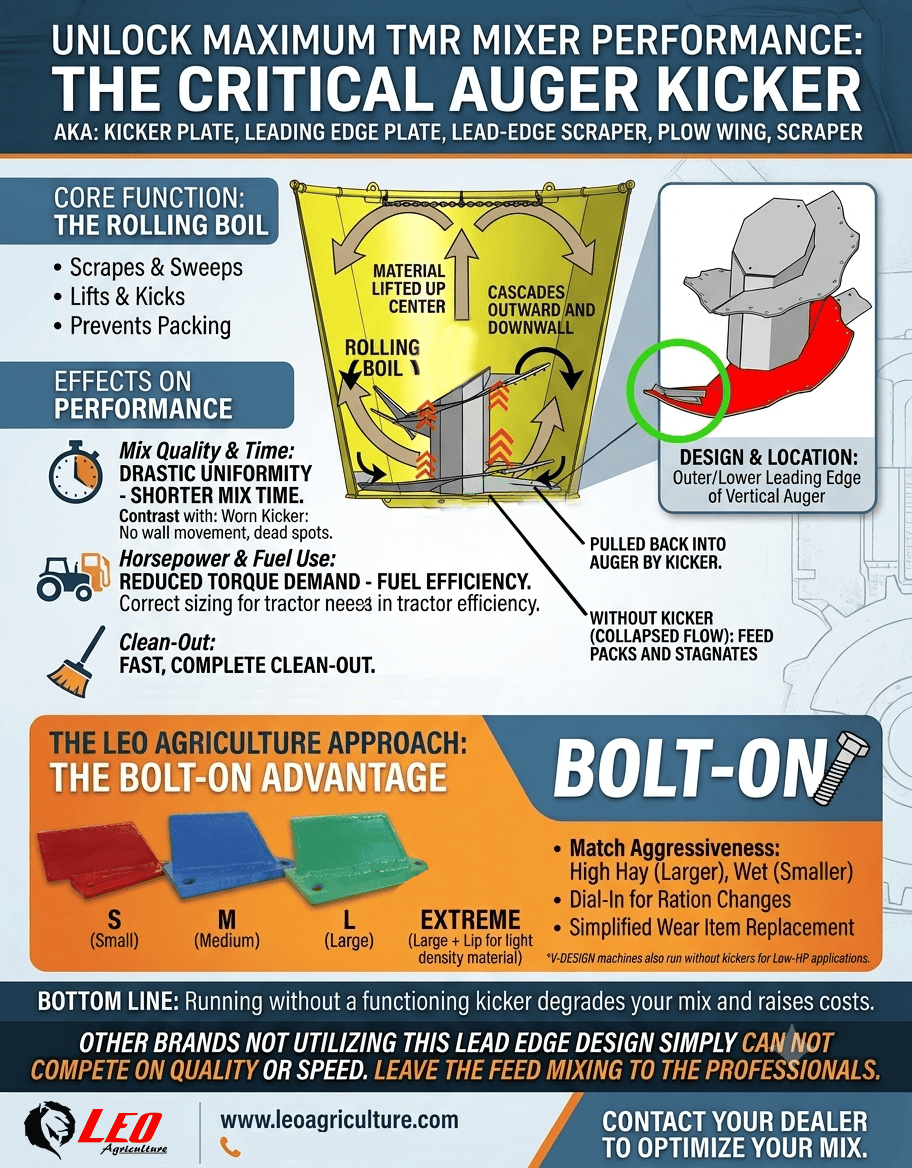
The auger kicker condition is separate from the oil circuit but worth inspecting at the same time, since a worn kicker forces longer mix cycles and puts more heat and load through the gearbox. A compromised oil circuit and a worn kicker together will cause failures that neither would cause alone. If you want to work through the kicker side of that, the earlier article on what a worn kicker actually costs you covers the diagnostic logic.
Steel Reservoirs and Line Spec: Why the Material Matters
Two material decisions affect how well a closed-loop system holds up across a South African season. First, the reservoir. Plastic reservoirs are common on cheaper machines and they work adequately in moderate climates. In sustained summer heat and UV exposure, plastic becomes brittle and develops stress cracks, often at the mounting bosses where vibration is highest. A steel reservoir does not degrade the same way. It handles vibration better and does not crack from UV exposure or temperature cycling.
Second, the lines. Standard rubber hose gets chewed. It is not a small problem on operations that have rodents near the feed area, which is most of them. Hydraulic-spec hose is manufactured to carry petroleum-based liquids and resists the acids in TMR feed material. Fittings secured with Loctite rather than hose clamps will not back out under vibration. These are not luxury upgrades. They are the difference between an oil circuit that lasts ten years and one that fails in three.
If you are currently evaluating what to look for in a new machine, the guide to choosing a vertical TMR mixer covers how these design decisions stack up across the full buying process.
The Inspection Takes Less Than an Hour
Run through the full circuit cold, before the first mix of the season. Check the sight glass, trace every line, feel every fitting, clear the reservoir breather, and look under the machine for any sign of a slow drip that developed over winter. If you find a kinked line or a weeping fitting, fix it before the daily schedule resumes. Replacing a fitting costs almost nothing. Replacing a gearbox bearing mid-season, in the middle of a KwaZulu-Natal summer, costs considerably more in parts, downtime, and the batch you lose while the machine sits.
Closed-loop oil checks done properly take most operators thirty to forty-five minutes. That is a reasonable price to pay before you load the first bale of the year.


Pingback: Shop Checks Returns Silage Season: The Pre-Batch Inspection Alberta Techs Actually Run - LEO Agriculture