

Stemmy, drought-stressed hay doesn’t behave the same as hay cut in a normal year. Operators in the Midwest and California’s Central Valley have been seeing it this summer: longer time at the tub, more heat off the gearbox, and batches that need another two or three minutes before the ration looks right. That’s not the recipe failing. That’s the forage pushing the machine closer to its limits than the machine was ever calibrated for.
Understanding where that friction comes from, and what to do about it before something fails, is worth more than any amount of ration adjustment.
What Drought Hay Actually Does to the Tub
A bale from a dry summer is denser and stiffer than one from a normal growing season. The cell walls in drought-stressed grass and legume stems are thicker, moisture content is lower, and there’s less of the leafy material that softens the bale’s outer layers quickly. When that bale hits the tub, the auger has to work harder to pull it into the cutting zone, and the knives are making contact with material that has more resistance per cut.
The practical effect is slower breakdown from the outside in. Instead of the bale shedding material at a steady rate into the pressure zones where cutting is most efficient, it tends to hold together longer. That means extended exposure to the high-load portion of the mixing cycle, which is where most of the wear and heat accumulate.
Flat-sided tub designs handle this better than round ones, because flat walls stop the bale from simply spinning and force it against the auger. That mechanical pressure is what actually drives material into the cutting zone. The geometry matters more when the forage itself is resisting breakdown.

Load Size and Knife Edge Condition Come First
Before adjusting anything else, check two things: what you’re loading per batch, and what condition your knives are in.
On a full-capacity load, drought hay expands significantly as it’s broken down. A tub that handles a normal mixed ration at 80 percent fill might be pushed past its working window if you’re running high-forage rations with drought bales. Material can climb above the effective cutting zone, and the auger starts moving a slug of feed rather than processing it. Dropping load size by 10 to 15 percent and observing whether process time normalizes is a quick, free diagnostic. If it does, you were overloading for the forage type you have right now, not for the forage you were buying six months ago.
Knife condition is more urgent than most operators treat it. A sharp knife edge reduces the force required per cut. A dull one makes the machine do more work for the same result, and that extra work shows up as heat in the gearbox and extended cycle time. With drought hay in the tub all summer, edges that were marginal going into the season are likely at or past the point where they’re costing you time every batch. The economics of replacing worn knife edges are straightforward: a modular knife system that lets you replace only the worn outer edge changes the cost calculation enough that there’s no reason to defer it.
Check gearbox temperature with your hand or an infrared thermometer at the end of a run. If it’s hot enough that you can’t hold your hand on the housing, the machine is working harder than it should be. That’s a symptom, not the problem itself. Don’t let it run hot repeatedly while you look for the cause.
Knife Placement and the Pressure Zone Problem
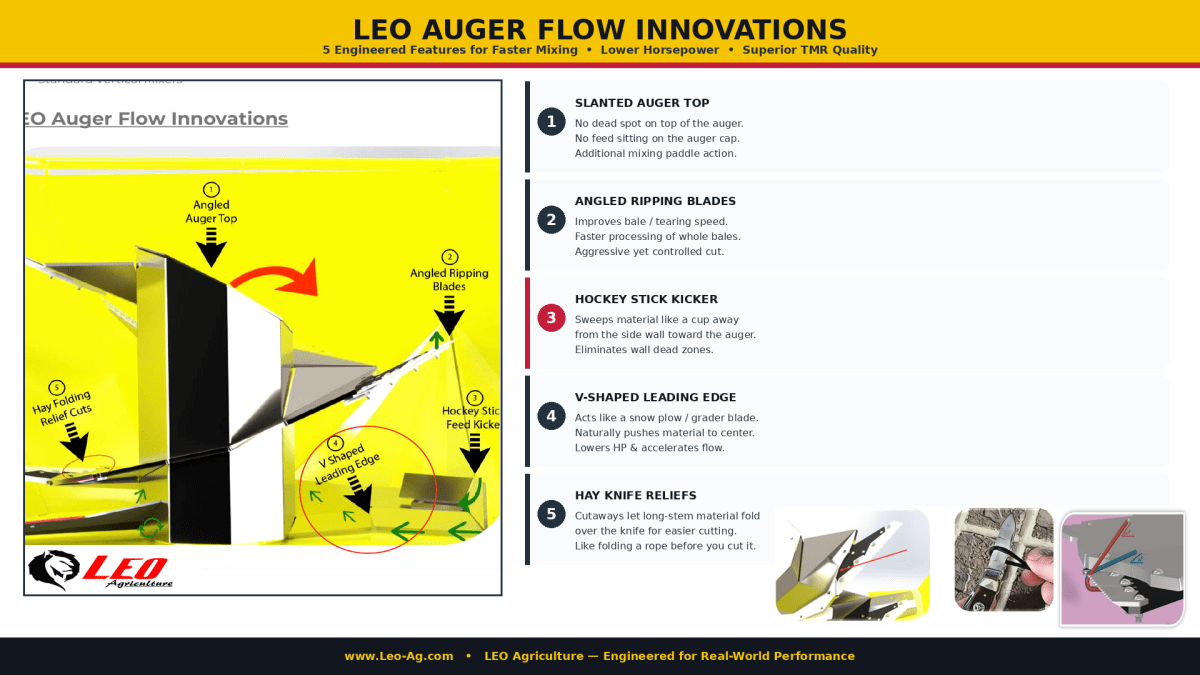
More knives is not the answer to slow processing. It’s a common instinct, but overloading the auger with knives disrupts the material flow patterns that make cutting efficient in the first place. The principle is that bales need to fall into the high-pressure zone near the bottom of the tub, where the auger creates the most mechanical force. If the top of the auger is crowded with hardware, the bale doesn’t drop cleanly into that zone.
For round bales specifically, there’s a practical caution worth keeping in mind: a large knife at the top position can cause the bale to ride up and spill material over the side rather than feeding into the cutting zone. With drought hay, where the bale is already resisting breakdown, the top position may need to be run with a lighter knife or no knife at all, letting the middle and lower zones do the work they’re designed for.
Square bales and high-leaf rations tolerate more knives at the top. But if your summer diet has shifted toward drought rounds, the knife layout that served you in spring may not be the right one now.
When the Setup Itself Is the Ceiling
There’s a point where load reduction and knife management stop gaining ground. When process time remains elevated after those adjustments, the question becomes whether the auger design and tub geometry were ever matched to the forage profile you’re running.
Capacity-specific auger design matters here. A single auger geometry applied across a wide range of machine sizes doesn’t perform the same way at every volume. The relationship between auger diameter, flighting pitch, and tub diameter determines how effectively material transfers from the outer wall into the cutting zone. Auger designs matched to each machine’s capacity handle the full range of forage types more consistently than generic geometry, and that difference is most apparent when you’re running difficult material like drought hay.
The tub floor geometry also plays a role that operators often underestimate. A flat-panel floor creates different material flow than a smooth round one. The interaction between the floor shape and the auger base determines how material cycles back into the cutting zone. That relationship between tub floor design and mixing time becomes visible when you’re working at the edge of the machine’s capability, which is exactly where drought hay puts you.
LEO Agriculture builds its VT and HD series with decagonal tub walls and capacity-matched augers for this reason. The design logic holds regardless of brand, though. What you’re looking for is whether the machine was engineered for the forage volumes and types you actually run, or whether it was built to a generic template that worked when conditions were average.
The Silage Season Running Right Behind This
Corn silage harvest is weeks away across most of the Midwest. That’s relevant now because a machine that’s already laboring on drought hay is not rested and ready. Silage adds weight per cubic foot and its own loading demands. If the gearbox has been running hot through August, if knife edges haven’t been addressed, and if load sizes haven’t been adjusted for the forage you’ve actually been running, the transition to silage season is when deferred maintenance becomes a breakdown.
Run a full inspection before the first silage load goes in. Check knife edges and torque specs, look at hydraulic line condition, and verify that your scale system is zeroing correctly under no-load conditions. A scale that has drifted means your ration accuracy has been drifting with it, quietly, all summer.
Drought hay turns process time into a daily cost most operations absorb without naming it. The cost shows up in fuel burn, in equipment wear, and in batch time that doesn’t get charged anywhere. Getting ahead of it before silage season is the practical move.
