

Older dairy barns were not built with modern equipment in mind. Feed alleys that made sense for a team of workers and a wheelbarrow become a genuine problem when you try to bring in a trailed mixer. Roof trusses sit low. Doorways are narrow. Turn radii at the bunk are short. A lot of small producers in the Free State and Mpumalanga have machinery sitting outside a barn it was never able to enter.
That is the real-world problem the compact single-auger mixer class was designed around, and it is worth understanding the geometry before buying anything.
What Loading Height Actually Limits
Loading height is the distance from the ground to the top of the mixing tub. It determines whether you can load bales or bulk materials without a loader taller than your roof allows, and it determines whether the machine clears the overhead structure inside the building at all.
The LEO Agriculture 7003 carries a loading height of 1.88 m (74 inches). For context, the 7004 sits at 2.03 m (80 inches) and the twin-auger 7006 VT at 1.98 m (78 inches). That 150 mm difference between the 7003 and the 7004 sounds minor on paper. In a barn with trusswork starting at 2.1 m, it is the difference between a machine that fits and one that does not.
Low loading height also has a practical daily benefit. A shorter tub means a shorter reach for anyone hand-loading concentrates or minerals from bags. On a 30-cow dairy where the feeding routine runs twice a day, that is not a trivial thing.

Narrow Tread in a Tight Feed Alley
Aisle width is the other constraint older buildings impose. Many free-stall and tie-stall barns built before the 1990s were designed around narrower machinery. Bringing a wide-tread mixer through a 2.4 m (8 ft) passage while the tractor is attached is an exercise in frustration at best and damage at worst.
The mini mixer class addresses this through narrow tread design. These machines are built to move through confined spaces where a full-size twin-auger trailed mixer simply cannot turn. That maneuverability is not just about fitting through a door once. It is about doing it twice a day, every day, for years, without clipping walls or stressing the hitch.
If you are still working out whether your barn geometry genuinely suits a compact machine versus something larger, the guide to choosing the right TMR vertical feed mixer covers the key decision points methodically.
The 7003 Engine Mini: When No Tractor Is Available
The 7003 is available in both PTO-driven and engine-driven configurations. The engine-driven version removes the tractor from the equation entirely.
That matters more than it might seem. On small mixed-farming operations, the tractor is often doing something else at feeding time. Ploughing, baling, running a water pump. Tying it to the mixer for an hour while someone else needs it creates scheduling friction that compounds across a week. An engine-driven mini mixer runs independently, which means feeding and fieldwork can happen at the same time.
Minimum power requirement on the PTO version of the 7003 is 16 kW (21 hp). That is accessible to a wide range of older utility tractors that are still common on small farms across southern Africa, tractors that would be underpowered for anything larger. The engine-driven variant sidesteps that question entirely.
Maximum mix weight is 875 to 965 kg. Capacity is 3 m³ (106 ft³). This is a machine built around herds in the 20 to 40 animal range, making consistent daily batches of mixed hay, silage, and concentrates without requiring significant infrastructure around it.
Single Auger Trade-Offs Worth Knowing
Single-auger machines have genuine advantages and real limitations. On the advantage side: simpler drivetrain, easier cleanout, and lower maintenance compared to a twin-auger configuration. More load per gearbox is the trade-off. For the batch sizes a 7003 handles, that load is well within the design range.
Single-auger machines in this class are not recommended for large round bales. The 7003 specification notes round bales as not recommended. This is not a failure of the design. It reflects what the machine is optimised for: pre-cut or smaller-format forage, concentrates, silage. If your ration is built mostly around large round bales processed whole, you need to look at a larger machine. If you are cutting, chopping, or using small-format hay, the 7003 is well suited to the work.
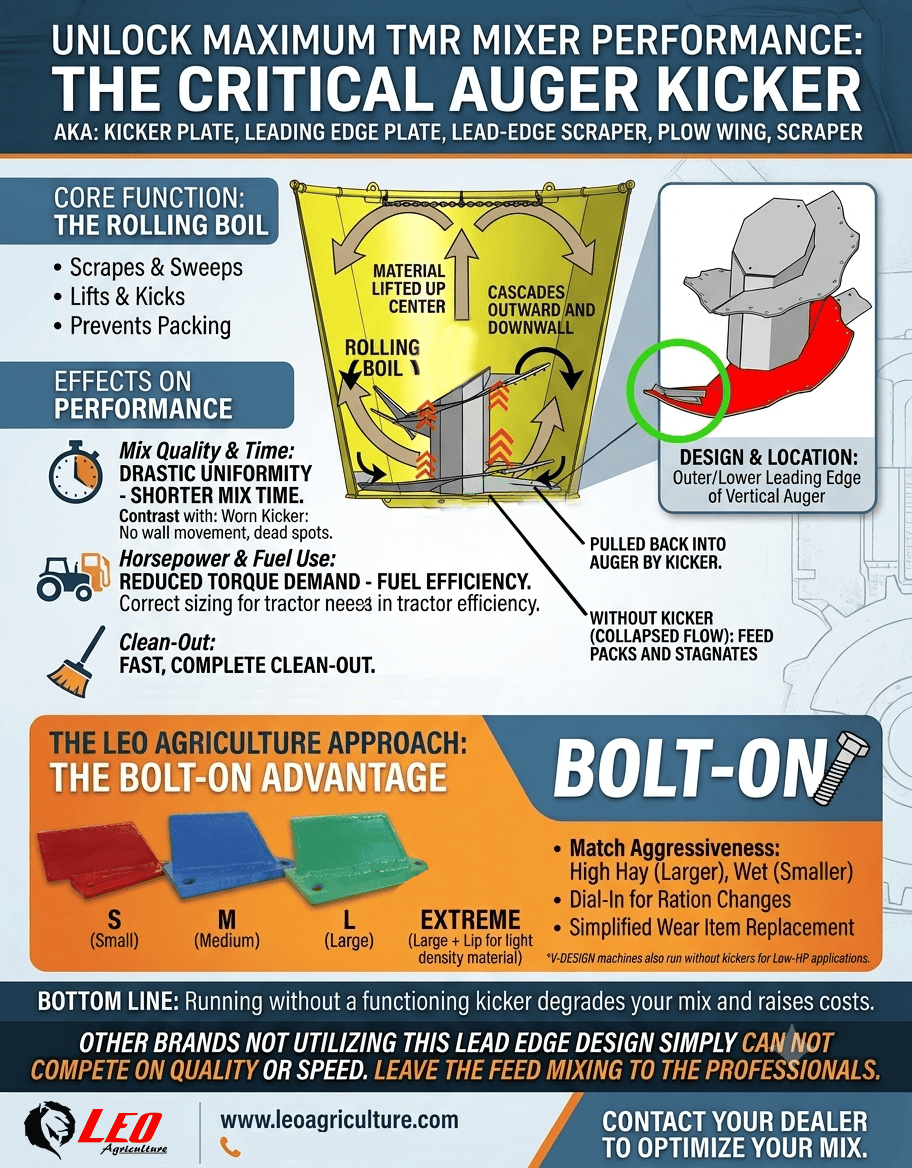
The auger is matched to the tub volume rather than being a generic design scaled across the range. Combined with the modular two-piece knife system, that means the cutting geometry is actually appropriate for a 3 m³ load rather than being an oversized or undersized carry-over from a different machine.
PTO or Engine: How to Choose
The choice between PTO and engine-driven comes down to three practical questions.
- Is the tractor reliably available at feeding time, or is it commonly doing other work?
- Is the tractor’s hydraulic and PTO output a good match for the mixer’s minimum requirements?
- Is there a covered working area with fuel storage, or will the engine-driven machine be maintained in the open?
If the tractor is always available and correctly sized, the PTO version is the simpler machine. Fewer components, no separate fuel system, no engine servicing interval to track. For most small dairy operations where the tractor is dedicated to feeding, that is the right answer.
Where tractor availability is genuinely constrained, or where the available tractor is marginal on power, the engine-driven 7003 is the more practical option. It is not a compromise. It is a different tool for a different operating condition.
Both versions carry the same low loading height and narrow tread. Both use the same auger, knife system, and tub geometry. The choice of drive type does not change the mixing result.
Scale Systems and Ration Accuracy on Small Herds
One area where small operations sometimes cut corners is weighing. Manual estimation works until it does not, and on a small herd the cost of an unbalanced ration shows quickly in milk production or condition scores. Optional scale systems are available across the mini range, and on herds where a nutritionist has prescribed precise ingredient ratios, fitting a scale to a machine this size pays for itself faster than most producers expect.
If you are still working out how much capacity your herd actually needs, including how to size for future growth rather than current numbers, the article on sizing a vertical TMR mixer for a growing herd is worth reading before you commit to a model.
Discharge Options for Floor and Bunk Feeding
The 7003 discharges through a right-side door. From there, operators can feed directly to the floor or fit a short incline conveyor to reach a raised bunk. In an older barn where the bunk height varies, or where floor feeding onto a concrete pad is standard practice, the side-door setup handles both without modification.
An optional slide tray is also available. On low-volume operations feeding into a narrow concrete channel, that tray controls where the feed lands and reduces waste. It is a small detail, but on a 25-cow operation mixing twice a day, reducing the amount of feed that ends up underfoot adds up.
The full mini mixer range from LEO Agriculture covers the 7002 through to the 7006 VT, with specifications for each model if you need to compare loading heights and capacities side by side before making a decision.
The bottom line on barn fit is this: measure the structure before you measure the herd. A machine that cannot get through the door or clear the trusses is useless regardless of its mixing quality. For producers working in older buildings with real dimensional constraints, the 7003 engine mini was designed with exactly those limits in mind.


Pingback: Why Cork Grazing Herds Still Need a Vertical TMR Mixer - LEO Agriculture